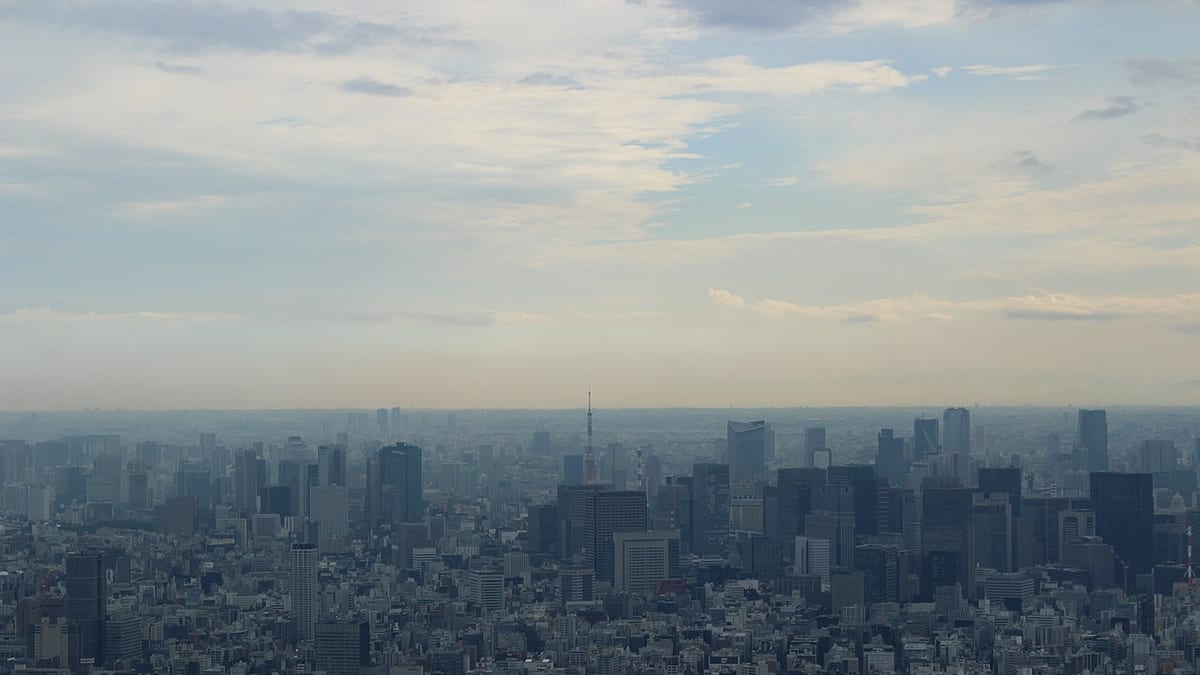
Tokyo Tower is worth visiting when you want a city view combined with time around Shiba Park and Zojoji Temple. Choose the Main Deck for the lower-cost observation experience; upgrade to the Top Deck Tour for additional height and presentation. However, photographing the tower itself and seeing the city from inside it are different outings.
That distinction matters when your itinerary already includes several observation decks. You do not need to buy every ticket to enjoy every landmark. Decide whether you are paying for a skyline view, the experience of entering this particular building, or a photograph of its red-and-white structure before choosing your visit.
Main Deck or Top Deck: what are you buying?
The tower stands 333 metres tall, but visitors do not go to that height. Its public observation levels are the 150-metre Main Deck and 250-metre Top Deck. The Main Deck also has glass Skywalk Windows looking directly down towards the ground. 1
These are the published standard adult prices:
| Ticket | Observation levels included | Adult admission |
|---|---|---|
| Main Deck | 150 metres | JPY 1,500 |
| Top Deck Tour, purchased online | 150 and 250 metres | JPY 3,300 |
| Top Deck Tour, purchased at the counter | 150 and 250 metres | JPY 3,500 |
The operator publishes separate younger-visitor rates. Select the correct age or school category rather than multiplying the adult price for the whole family. 2
For an adult comparing the two standard experiences, the online Top Deck ticket costs JPY 1,800 more than Main Deck admission. That is the meaningful upgrade comparison: the higher-level ticket already includes the lower level. Buying both separately is not the normal way to see both.
Choose the Main Deck when your main aim is a reasonably priced view and you are happy with the lower observation height. Choose Top Deck when entering the upper space is part of the attraction, rather than simply a way to collect a higher number on your itinerary.
The Top Deck experience includes a staged introduction to the tower, a change of elevators, mirrored interiors and accompanying drink and photo-card benefits. It is more than an extra lift ride, though the value of those additions is personal. 3 A visitor interested primarily in photography may judge the upgrade differently from someone celebrating an occasion.
Match the visit to the view you actually want
Daylight is my recommendation for identifying neighbourhoods and understanding the surrounding city. After dark, choose the visit for illuminated buildings and atmosphere rather than expecting the same clarity of distant detail. A sunset booking can combine both, but it also ties your schedule to a particular period.
Visibility matters more than a promotional photograph suggests. GO TOKYO notes that Mount Fuji can be seen on a clear day; it is not a promised part of admission. 1 Treat a distant mountain sighting as a bonus, not the sole reason to commit to an expensive ticket.
The published Main Deck hours are 09:00–23:00, with last entry at 22:30. Top Deck closes at 22:45, with final admission at 22:15. The operator warns that Main Deck admission may finish earlier when crowded. 2 Do not build a plan around arriving at the final advertised minute.
For a sunset visit, my planning recommendation is to reach the tower before the period you most want to photograph. Allow time to find the entrance, deal with tickets and move through the building. A reservation time is not permission to arrive at the nearby station at that moment.
Understand the Top Deck reservation before paying
Top Deck requires a reservation, made online or at the counter. You may enter the Main Deck before your booked upper-level time, but going back down to ground level ends your entry. Arriving late invalidates the Top Deck reservation without a refund, although Main Deck access remains possible. 4
Use that arrangement sensibly: explore outside first, then begin the indoor visit. Do not enter early expecting to leave for lunch and return later on the same ticket.
For purchases made from 1 November 2025 onward, the stated cancellation charge becomes 100% from two days before the visit. Dates and times cannot simply be edited; changing plans requires cancellation and a new purchase under the applicable conditions. Operator cancellation for severe weather is different from disappointing visibility, and triggers the published refund procedure. 4
The practical choice is between securing a preferred slot early and retaining flexibility over the weather. Neither is universally better. For a fixed celebration, the slot may matter most; for a traveller with several free afternoons, leaving the exact visit flexible can be more useful than a small advance-purchase saving.
The stairs are an experience, not a cheaper ticket
The open-air stair route climbs approximately 600 steps to the Main Deck. The published regular upward-opening schedule is weekends and public holidays, 09:00–16:00; the downward route has different hours. Normal observation admission is still required. 5
Choose this option because you want to climb the structure, not because you expect a free route to the view. There is no mid-route switch to an elevator. You can use the elevator when returning from the Main Deck, and rain, severe weather or heat alerts can suspend the stairs. 5
Consider the least enthusiastic member of your party before choosing the climb. A group interested mainly in the view may get more from saving its energy for the surrounding neighbourhood. Agree on the route beforehand rather than turning the stair entrance into an argument about stamina.
For wheelchair users, the operator describes barrier-free assistance from the entrance to the Main Deck elevator and asks visitors to contact staff when moving between its levels. Accessible toilets are listed on Main Deck level two and Foot Town levels one and two. 6 These arrangements should not be assumed to establish suitability for every upper-deck requirement; discuss your particular needs before booking that experience.
Arrive by the useful station, not automatically the closest one
The operator lists Akabanebashi's Akabanebashi exit as a five-minute walk, Onarimon exit A1 as six minutes, and Kamiyacho exit 1 as seven minutes. Hamamatsucho's north exit is approximately 15 minutes away. These are walking estimates, not complete journey times. 7
A direct train to a slightly more distant station can be preferable to changing lines just to shorten the final walk. Compare the entire hotel-to-tower journey, including transfers and the exit you will use. Visitors needing lifts should check the accessible station route rather than following an exit recommendation intended simply to minimise distance.
Allow time outside as well. Zojoji Temple and Shiba Park provide views of the tower as part of the cityscape, rather than views from inside it. GO TOKYO specifically identifies them as nearby places to explore and photograph the landmark. 1
My preferred sequence is neighbourhood first, observation deck second, then a final look back at the illuminated exterior when the timing suits. A budget visitor can omit the paid ascent and still enjoy the tower's setting. A visitor who values the structure and the skyline can choose one deck experience without feeling obliged to buy every upgrade.
Sources
- GO TOKYO - Tokyo Tower and surrounding neighbourhood
- Tokyo Tower - admission prices and opening hours
- Tokyo Tower - Top Deck Tour experience
- Tokyo Tower - Top Deck Tour FAQ and cancellation terms
- Tokyo Tower - Open-air Stair Walk
- Tokyo Tower - accessibility information
- Tokyo Tower - access and station exits