For most visitors travelling from Tokyo to Kawagoe, the best route is the one nearest their hotel: Tobu from Ikebukuro, Seibu from Seibu-Shinjuku or Takadanobaba, or JR from Shinjuku. Compare the arrival station as well as the train time. Hon-Kawagoe and Kawagoe are different stations, and a sightseeing pass is not automatically the cheapest or simplest choice. [1]
Three routes, three different calculations
Kawagoe's tourism association lists the fastest Tobu service from Ikebukuro at approximately 26 minutes, the JR Saikyo rapid route from Shinjuku at approximately 50 minutes, and Seibu's limited express from Seibu-Shinjuku at approximately 44 minutes. These are rail timings, not hotel-to-historic-district timings. [1]
| Starting point | Practical route | Arrival station | Main reason to choose it |
|---|---|---|---|
| Ikebukuro | Tobu Tojo Line | Kawagoe or Kawagoeshi | Fast access from northern Tokyo |
| Seibu-Shinjuku or Takadanobaba | Seibu Shinjuku Line | Hon-Kawagoe | Convenient approach to the central shopping area |
| JR Shinjuku | JR Saikyo/Kawagoe route | Kawagoe | Useful when already near JR platforms |
The fastest option on paper can lose its advantage if you first cross Tokyo to board it. Start with your hotel's nearest useful station, then add the walk or bus at the Kawagoe end. Also distinguish JR Shinjuku from Seibu-Shinjuku: buying a Seibu ticket does not put the train inside the JR gates.
For Tobu and JR, read the destination and stopping pattern before boarding. A route shown in a planner may include a change, and not every train on the same coloured line reaches the same endpoint. Follow the itinerary for the particular departure rather than memorising a line name alone.
Kawagoe, Kawagoeshi and Hon-Kawagoe are not synonyms
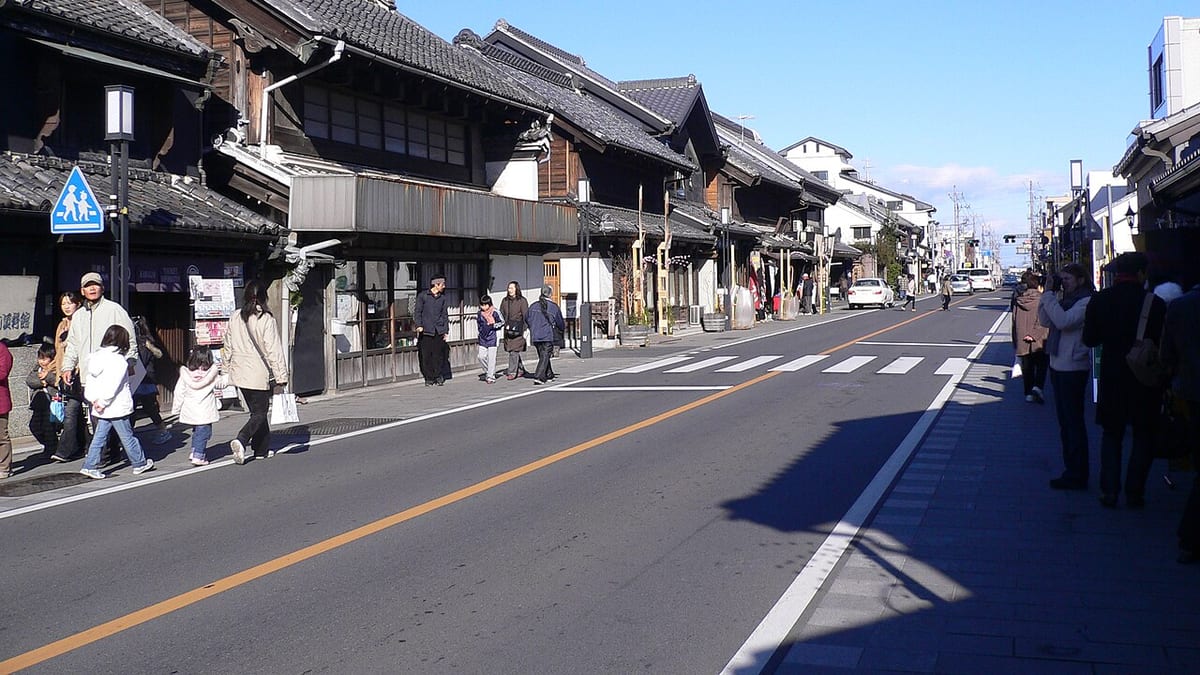
This station distinction is useful even before you choose a pass. The official access information for Koedo Kurari, the former brewery complex, gives a walk of about three minutes from Hon-Kawagoe versus 15 minutes from Kawagoe Station. The difference is meaningful when you plan to begin with a meal or shopping there. [2]
A station that is slightly farther from your first attraction may still be better for your whole day. For example, arriving at Kawagoe and using a local bus can make sense if you want to distribute sightseeing over a wider area. Arriving at Hon-Kawagoe and walking suits a compact outing with fewer paid connections.
Mark the first and last places you intend to visit before deciding. A route that begins around Kurari, continues through the old commercial streets and ends near another bus stop may not need the same station at both ends. Whether your ticket permits that flexibility is a separate question.
Avoid treating all buses marked with "Koedo" as one network. The coverage of a Tobu pass and a Seibu/Eagle Bus combination is different. A familiar sightseeing name on a bus is not sufficient proof that your ticket is valid.
Tobu's premium pass: useful when you will ride the buses
Tobu's current Kawagoe Discount Pass Premium costs JPY1,200 for adults and JPY600 for children. It includes a return journey from Ikebukuro to Kawagoe or Kawagoeshi, unlimited travel between those two stations and specified Tobu bus services, including the Tobu Koedo Loop Bus. The operator explicitly limits the bus benefit to designated sections. [3]
Choose it when the included buses genuinely match your itinerary. The attraction is less "unlimited travel" in the abstract than removing individual fare decisions on a day involving several covered journeys. It can also be useful when you prefer not to commit to a long continuous walk.
For a traveller planning only one return train journey and a compact walking route, compare ordinary fares before purchasing. An unused bus allowance has no value. Likewise, shop discounts should be treated as bonuses rather than a reason to visit places that were not otherwise on your list.
Use the current product page, not an old downloadable leaflet or a blog's historical price. The relevant comparison here is the operator's JPY1,200 premium product as checked in October 2026. [3]
Seibu: distinguish the basic pass from reserved-seat travel
The Seibu Kawagoe Pass costs JPY1,000 for adults and covers one return trip between Hon-Kawagoe and the Tokyo-side stations Seibu-Shinjuku, Takadanobaba or Ikebukuro. The return can finish at a different one of those three stations, but intermediate stopovers are not permitted. It is intended for eligible foreign travellers, and the paper version requires the prescribed identification at purchase. [4]
The important exclusion is the limited-express supplement. A basic Kawagoe Pass is not a reserved seat on the Red Arrow limited express. If you choose that train, you need the additional limited-express ticket. The operator also offers a digital version, but buying on a phone does not remove that supplement. [4]
For a straightforward reserved-seat outing, Seibu's separate Kawagoe Access Ticket includes the return basic fare and limited-express reserved seats between Seibu-Shinjuku or Takadanobaba and Hon-Kawagoe. The published price is JPY1,800 for adults and JPY700 for children, bought at the specified station counters for same-day use. [5]
For two adults, that is a calculated JPY3,600, compared with JPY2,000 for two basic Seibu passes before any limited-express extras. The JPY1,600 difference buys a different travel product; it should not be described as a fare saving without comparing the trains and supplements you would otherwise purchase.
There is also a JPY1,500 adult Seibu Kawagoe Pass with an Eagle Bus CO-EDO Loop Bus day ticket. Its bus coverage is not interchangeable with Tobu's premium pass, and limited-express tickets still cost extra. Decide which local route you need before choosing between the two operators' bundles. [4]
Plan the day around the journey you will actually take
For a relaxed first visit, choose one arrival station, a compact sequence of sights and a lunch stop before adding distant attractions. Treat a reserved return train as an appointment: leave time to reach Hon-Kawagoe rather than assuming every nearby rail entrance is the right one.
If you prefer an open-ended afternoon, an ordinary service may be more convenient than fixing the end of the day around a reserved seat. Conversely, a limited express is attractive when sitting together matters more than keeping every minute flexible. This is a comfort decision as much as a timetable decision.
Keep shopping practical. A large or fragile purchase is easier to carry on a simple journey with fewer changes, so the best return route may be different from the route with the shortest published train time. Ask a shop about packaging before committing to pottery or glass that will travel through busy stations.
For travellers with limited walking endurance, calculate the whole chain: hotel to station, station to sightseeing area, movement within the town and the final return. A bus-inclusive pass can help, but it cannot remove every walk or guarantee a seat. Build in a seated meal and fewer stops rather than using a pass as an invitation to cover every attraction.
The most efficient Kawagoe trip is usually not the one with the most transport included. It is the one that starts near your hotel, arrives near your first stop and ends at a station your ticket actually covers.