Yes: Tokyo Metro accepts eligible contactless bank cards and supported smartphone payments, following the launch of its expanded tap-to-ride service on 25 March 2026. However, this is not universal contactless payment across every Tokyo railway. Use it for a clearly supported journey; keep Suica or another suitable ticket for routes that continue onto excluded operators. 12
The important distinction is between a contactless bank card and a transport IC card. Both can be tapped, but they use different payment systems, fare rules and coverage. Advice that simply says "Tokyo is contactless" leaves out the part most likely to cause difficulty at a transfer.
What you can tap, and how to begin
Tokyo Metro's service accepts qualifying credit, debit and prepaid cards with contactless capability. Its listed physical-card brands include Visa, Mastercard, JCB, American Express, Diners Club, Discover and UnionPay; the supported smartphone-brand list is narrower. Use a dedicated reader displaying the relevant payment symbol, not an assumption that every gate surface accepts every card. 2
Take the selected card out of a wallet containing other contactless cards. On a phone, know whether you are presenting a bank card or a stored-value Suica. That distinction matters when you later look for the fare or try to finish the journey.
No advance registration is required to ride. Registration with Q-move is instead used for viewing the service's journey history. Toei publishes this distinction clearly for the shared system. 3
For a first journey, choose a straightforward route and leave time to ask staff before entering. Testing an unfamiliar payment arrangement while rushing for the last train creates a problem that saving a minute at a ticket machine cannot justify.
Keep the same card or device for the whole journey
Enter and leave using exactly the same payment method. A physical bank card and its version on a phone are not interchangeable for completing the trip, even when they draw money from the same account. The same caution applies when choosing between a phone and watch. 3
For example, entering with the card in your hand and exiting with your phone can leave the system without a matched journey. Choose the device at the beginning and keep it available until after the exit gate.
Each traveller needs an appropriate payment method of their own. This is not a system in which one adult repeatedly taps the same card to take several friends through. The operator permits use by the named cardholder, not card sharing. 3
When travelling together, decide payment arrangements before reaching the gate. A couple using different systems can still travel together, but each person must finish their own entry-and-exit record correctly.
Supported subway lines do not mean every connected railway
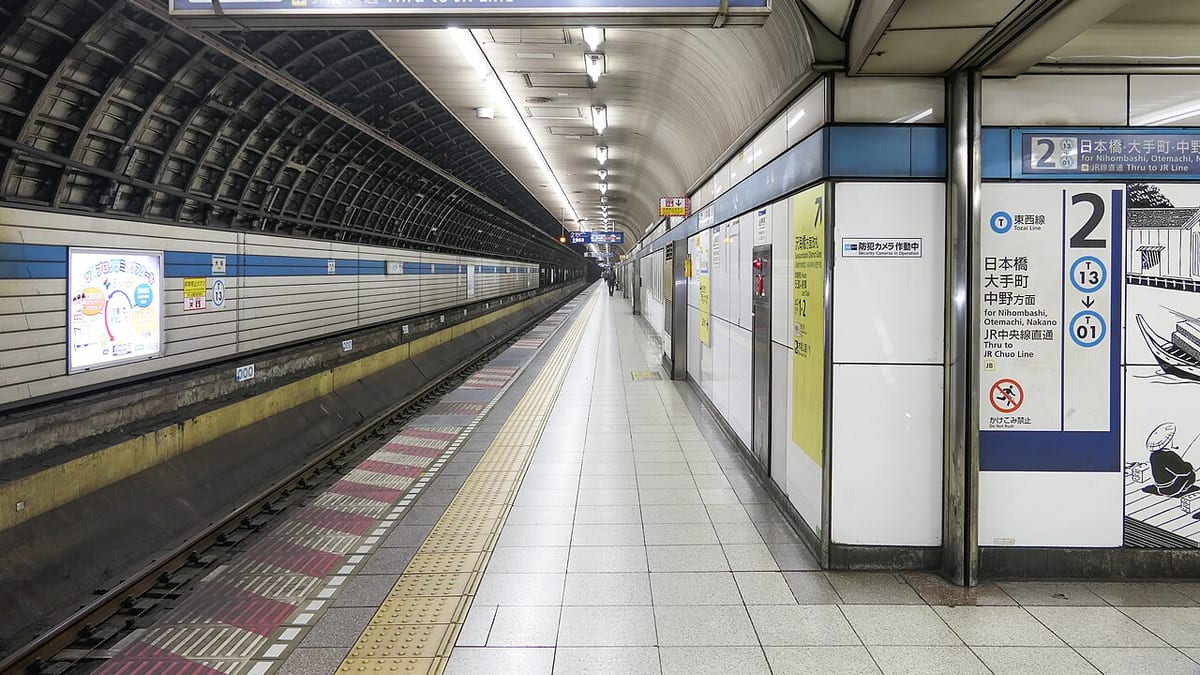
Metro's bank-card service covers its lines, with a specific exception at Nakano: you cannot enter there using tap-to-ride. Travellers who entered with the service elsewhere and leave at Nakano must have the fare processed at the staffed gate using the original payment card. 2
This is especially important on the Tozai Line. A train's destination board and through-running route matter, not just the line on which you first boarded.
The shared network includes Tokyo Metro, Toei and participating stations of several private railways. It does not include JR East. Toei also explicitly warns that the service is unavailable at Narita Airport and Airport Terminal 2 stations and does not cover Keisei or Hokuso journeys. 3
A sensible rule is to inspect the entire proposed route before tapping in. A supported first section does not validate an unsupported final section. For an itinerary mixing the Yamanote Line, subways and other operators, a transport IC card remains a simpler default because it avoids repeatedly evaluating bank-card coverage. JR East explains Suica's use across participating transport networks separately. 4
Bank-card fares are not identical to Suica fares
Tokyo Metro charges the ordinary ticket fare in ten-yen increments for bank-card journeys, rather than the IC fare in one-yen increments. The service applies adult fares only. Eligible Metro–Toei transfers receive the published ¥70 connection discount. 2
The distinction is small on some individual rides but important conceptually: paying with a bank card is a convenience option, not an automatic discount product. Do not treat a card tap as purchasing a Tokyo Subway Ticket or unlimited daily travel.
A family should therefore compare children's proper transport tickets or child IC cards rather than simply give everyone an adult bank-card payment method. Likewise, a traveller making many covered subway trips should compare the appropriate pass with pay-as-you-go fares. The current visitor-ticket page sets out the separate 24-, 48- and 72-hour products. 5
Avoid focusing so heavily on a few yen that you choose an inconvenient route. Payment simplicity is useful, but the best journey may still involve an operator or ticket outside this system.
Transfers require attention to the gate, not just the platform
When a Metro–Toei transfer involves leaving and re-entering the fare gates, exceeding 60 minutes means a new fare is required under the published contactless conditions. The service also cannot be combined within a journey with other tickets or passes. 2
Treat an interchange as an interchange. A long lunch outside the gates should not be planned as though you were still simply walking between platforms.
Similarly, do not enter with a bank card and expect to finish by presenting a subway pass. Decide which ticket covers the journey before boarding. When changing payment systems between separately paid trips, complete the first trip properly, then begin the next with the new method.
The practical advantage of this discipline is easier troubleshooting. You can explain where you entered, where you left and exactly which card or device you used, rather than trying to reconstruct several overlapping payment methods.
What to do when the gate does not open
Move aside and consult staff instead of repeatedly switching cards against the reader. Show the payment method used at entry and the station you intended to reach. Keep a backup payment option available, but let staff resolve an incomplete journey before creating another one.
For a questionable charge, start with the journey record rather than the bank's notification alone. Toei explains that a day's fares are combined for settlement; the bank's eventual posting time depends on the issuer and card type. 3
For visitors staying mainly within supported subway routes, bank-card tapping can remove the need to buy and replenish a separate travel card. For mixed-network sightseeing, families seeking child fares, or travellers using a pass, Suica and conventional tickets still have distinct advantages.
The answer is therefore yes - but choose contactless bank-card travel because it fits your actual route, not because it sounds like a universal replacement for every Tokyo ticket.