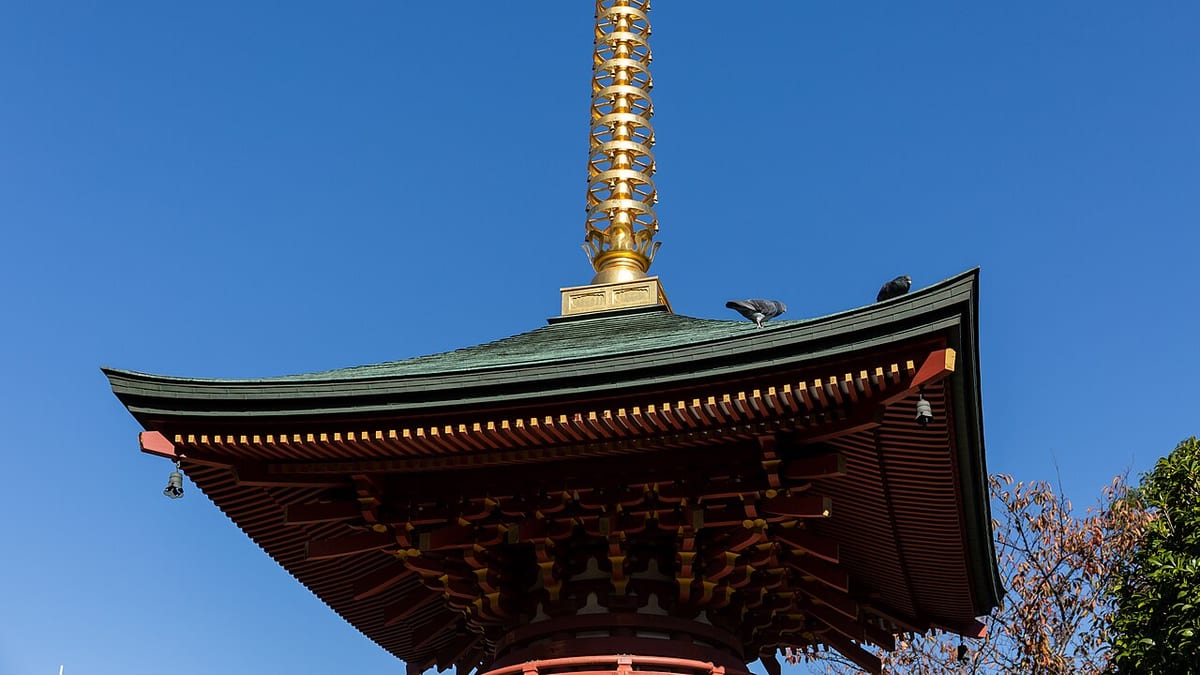
Sensō-ji is worth visiting for its combination of an active Buddhist temple, monumental gates and the surrounding Asakusa neighbourhood. It is less suitable when you expect a secluded spiritual retreat or an untouched ancient building. Choose your time according to whether worship, architecture or shopping matters most; one visit cannot guarantee the best version of all three. 12
What you are actually coming to see
Sensō-ji identifies itself as Tokyo's oldest temple and centres its worship on Kannon, the bodhisattva of compassion. Its foundation story tells of fishermen finding a sacred image in the Sumida River in 628. Treat that account as the temple's religious tradition, rather than presenting every element as independently established historical evidence. 1
The most useful detail for visitors is that the principal image is hidden from public view. You are not buying access to a famous statue displayed inside a gallery. The significance of the visit lies in the place of worship, its architecture and practices, not an expectation of seeing that image. 1
The approach provides a clear sequence: Kaminarimon, the Nakamise shopping street, Hōzōmon and the main hall. The large lanterns and gates make an immediate impression, while the surrounding complex gives you reasons to pause beyond the most photographed viewpoint. 34
Do not interpret the age of the institution as the age of every visible structure. Tokyo's official guide explains the impact of wartime destruction and rebuilding. That does not make the temple inauthentic as a place of worship; it changes the story from one of untouched survival to one that includes reconstruction and continuity. 3
For a first visit, choose a few things to notice carefully: the transition from the commercial approach to the worship space, the relationship between the gates and hall, and the different activities taking place around you. That produces a richer visit than moving rapidly between familiar photographs.
Free entry does not mean everything nearby is included
The ordinary temple visit is free. You do not need to buy a general admission ticket simply to approach the main hall and explore the publicly accessible grounds. Guided tours, fortunes, amulets, purchases and any specially ticketed opening are different transactions. 5
This matters when comparing a paid activity advertised as including Sensō-ji. The cost may be for guiding, a neighbourhood experience or another service - not an entrance fee that an independent visitor must pay. Judge that activity by its actual added value.
A guide can still be worthwhile when you want help understanding practices, architecture or local history. Free access does not mean interpretation is unnecessary; it means you can decide whether to buy it rather than assume it is compulsory.
For a family or a budget-conscious traveller, the absence of ordinary admission makes a short visit easy to justify. You can spend an hour without needing to remain longer to recover the cost of an expensive ticket. Set a separate shopping budget if the approach is likely to tempt you into unplanned purchases.
Morning, daytime or evening? Choose the trade-off
The temple publishes main-hall opening of 06:00–17:00 from April through September, and 06:30–17:00 from October through March. Other halls have their own arrangements. Do not turn the wider grounds' accessibility into a claim that the main hall is open around the clock. 6
I would choose early morning when the religious and architectural setting is the priority. You may have a simpler visit before the busiest shopping period, but quieter is a relative expectation, not a guaranteed empty photograph. A festival or special service can change the atmosphere substantially.
Daytime is the better choice when Nakamise and the wider shopping streets are an important part of your plan. Shops operate independently of the temple's early opening, so arriving for the earliest hall access is not a promise that you can also buy every snack or souvenir on your list. 2
An evening visit can be attractive for the exterior atmosphere, but it is a different experience from entering the hall during its published hours. Do not arrive after closing and describe the whole visit as disappointing because the activity you wanted has already finished.
For someone staying nearby, two short visits can work well: a focused temple visit in the morning and an exterior stroll later. For someone crossing the city, one well-timed visit is usually more efficient than returning solely to recreate a second photograph.
How much time should you give it?
Allow roughly 60–90 minutes for the temple and immediate approach, or longer when you want a meal and some neighbourhood exploration. These are planning suggestions, not measured averages. Shopping, photography and a guide can change the duration far more than the distance on a map suggests.
The strongest itinerary gives Asakusa a coherent portion of the day. Tokyo's tourism guide highlights the district's traditional shops and entertainment heritage; it is not simply the name of the station beside a temple. Choose a nearby secondary interest instead of immediately travelling to the opposite side of Tokyo. 2
Do not automatically combine every eastern-Tokyo attraction into one continuous walk. A route that looks tidy on a screen may become tiring once you include time standing in shops and waiting around crowded entrances. Preserve one proper break rather than treating food as something to fit in while moving.
With children, keep the explanation concrete and the route short. Gates, lanterns and different building shapes are easier to engage with than a dense historical lecture. Avoid turning the visit into a test of how long everyone can remain interested in the same subject.
Getting there and behaving as a visitor
Asakusa is served by several operators, including Tokyo Metro, Toei, Tobu and Tsukuba Express. Their stations are not all one identical entrance. Follow the route for the line you are actually using and identify the appropriate exit, especially when arranging a meeting point. 4
During worship, keep the central approach usable and avoid turning a prayer space into a photo set. The temple's guidance describes joining the hands in Buddhist prayer; watching respectfully is also an option when you are not participating. You do not need to imitate every gesture to appreciate the setting. 1
Follow local signs on photography and access. A building visible from the grounds is not necessarily open for interior exploration. Do not assume that the pagoda, garden or every smaller hall has the same access arrangement as the main visitor approach.
Sensō-ji deserves a place on many first Tokyo itineraries because it brings religion, architecture and neighbourhood life together without requiring a costly booking. Give it the right expectations: an important, busy and living temple, not a private encounter with an exposed ancient treasure. That distinction is the difference between merely recognising the gate and understanding why the visit is worthwhile.