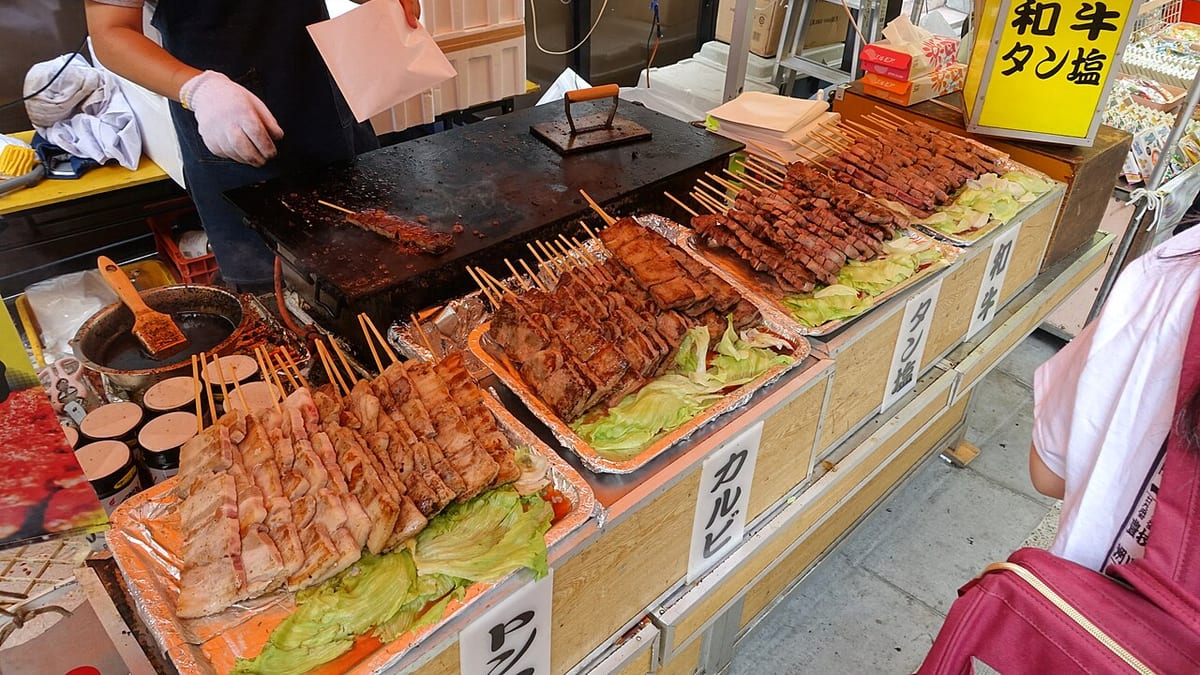
For food during Sanja Matsuri in Tokyo, plan one proper seated meal and leave festival snacks as an optional extra. Choose the restaurant for its location, menu and booking conditions - not simply its fame. If dietary requirements or children make improvising difficult, settle those details before entering the busiest part of Asakusa.
There is no single meal that every Sanja Matsuri visitor needs to eat. The festival is associated with Asakusa Shrine and neighbourhood processions; its future stall mix should not be confused with a permanent restaurant guide. The next indexed shrine notice lists 14–16 May 2027, but no complete 2027 food-stall programme is established here. 1
Make lunch a decision, not a gap between processions
First decide whether the meal or the moving procession has the fixed time. A restaurant booking can give the day structure, but you must be willing to leave the street in time to reach it. If you intend to follow whatever develops, choose a flexible meal plan instead of risking a reservation you cannot honour.
Keep the restaurant on the same side of the area as your planned viewing where possible. A small distance on a map can still require passing through a crowded approach. Save the exact entrance and the business name in Japanese rather than relying on a photograph of its food.
The recommendations below are based on published menus, operator information and local merchants' listings. They are not a personal tasting ranking, and ordinary opening hours do not confirm a particular festival day's service.
Asakusa Imahan: a planned wagyu meal, with conditions
Asakusa Imahan's Kokusai Street Head Restaurant, at 3-1-12 Nishi-Asakusa, serves sukiyaki and shabu-shabu. It makes sense when a substantial wagyu meal is part of the outing rather than a quick stop between sightings. Specify the exact restaurant when booking; a familiar "Imahan" name alone is not enough. 2
Its published terms reveal two useful limitations. The restaurant does not accept reservations for the lunch menu, and children under thirteen are not permitted in its private rooms. Neither rule means the entire restaurant excludes children or that every meal is unbookable. Discuss the appropriate menu and seating arrangement directly. 2
A lower advertised lunch price should therefore not be treated as a guaranteed, reservable festival meal. The operator also warns that service can finish early when seating or queues require it. Choose a reservable arrangement that suits your group, or retain a genuine alternative instead of making a limited lunch offer the day's only food plan. 2
This is the better choice when you want to sit, eat deliberately and make the restaurant a main activity. It is the wrong choice when you are unwilling to step away from a procession at an agreed time.
Daikokuya: tendon near the temple approach
The Asakusa Merchants Association identifies Daikokuya, at 1-38-10 Asakusa, as a long-established restaurant known for tendon, tempura served over rice. Its position around Denboin-dori makes it a relevant option for a meal near the central sightseeing area. 3
Choose it because you want that style of meal, not because every old restaurant must be superior to a newer one. A famous address is not proof that it will be the quickest available lunch during a festival.
Have a clear decision before joining a queue: how long are you comfortable waiting, and what will you do if that interferes with the part of the festival you want to see? Do not split your group between a restaurant line and a procession unless everyone is comfortable with missing one or the other.
If the restaurant is the priority, give it its own generous meal window. If the festival is the priority, treat the restaurant as an option rather than an obligation. That distinction prevents a recommendation from becoming a source of frustration.
Tempura Asakusa Sakura: investigate specific dietary needs
Tempura Asakusa Sakura explicitly addresses halal, gluten-free and vegetarian dining in its own information. That makes it a more useful starting point for relevant dietary enquiries than assuming an ordinary tempura menu can simply remove one ingredient. 4
Tell the restaurant exactly what matters to you and ask about the chosen dish, sauces and preparation arrangements. A menu category is not a personal assurance about an allergy or medical requirement. For a serious restriction, obtain an answer you understand before booking rather than trying to solve it at a busy counter.
This recommendation is based on the operator's stated provision, not an independent inspection of certification or kitchen practice. The practical advantage is that these questions are part of the restaurant's published offer and can be raised in advance.
Avoid combining incompatible priorities. Someone who needs a confirmed seated meal should not depend entirely on an unannounced temporary stall, even if companions would be happy to browse and snack. Agree on a shared meal first, then allow others to add festival purchases separately.
Kimuraya Honten: a snack or souvenir, not lunch
For a small Asakusa purchase, Kimuraya Honten sells ningyoyaki and other sweets on Nakamise. The shopping street's own listing places this shop at 2-3-1 Asakusa and describes cakes shaped around local motifs. Use the exact name and location, because Nakamise also lists another similarly named Kimuraya business. 56
A bag of sweets fits a flexible festival visit better than a second full restaurant reservation. Buy what you can comfortably carry and ask the shop about storage if taking it home. Do not assume that every filling or product meets a dietary requirement because the item looks simple.
Eat where the business indicates and step out of the walking stream. Balancing food, a phone and a camera makes it harder to respond when a procession or steward needs people to move. Keep the food break distinct from active crowd viewing.
Build a plan that survives a changed route
A workable sequence is a normal breakfast, one deliberate lunch or early dinner and a small optional snack. The exact hours should follow the current festival programme and your reservation, not a generic claim about the best time to avoid queues.
Keep an alternative near your hotel or onward station. This is especially useful when the day's viewing moves you away from the restaurant you initially considered. There is no loss of authenticity in eating a comfortable meal outside the busiest streets after enjoying the festival.
Carry a little cash without assuming every business is cash-only, and keep the booking confirmation accessible offline. When you arrive, confirm the branch and party size before being seated. If plans change, cancel promptly rather than holding a table you no longer intend to use.
The best Sanja Matsuri food plan leaves you fed, rested and free to enjoy the neighbourhood. One meal chosen for the right reasons will usually serve the day better than a long checklist of famous foods you must somehow fit between moving shrines.