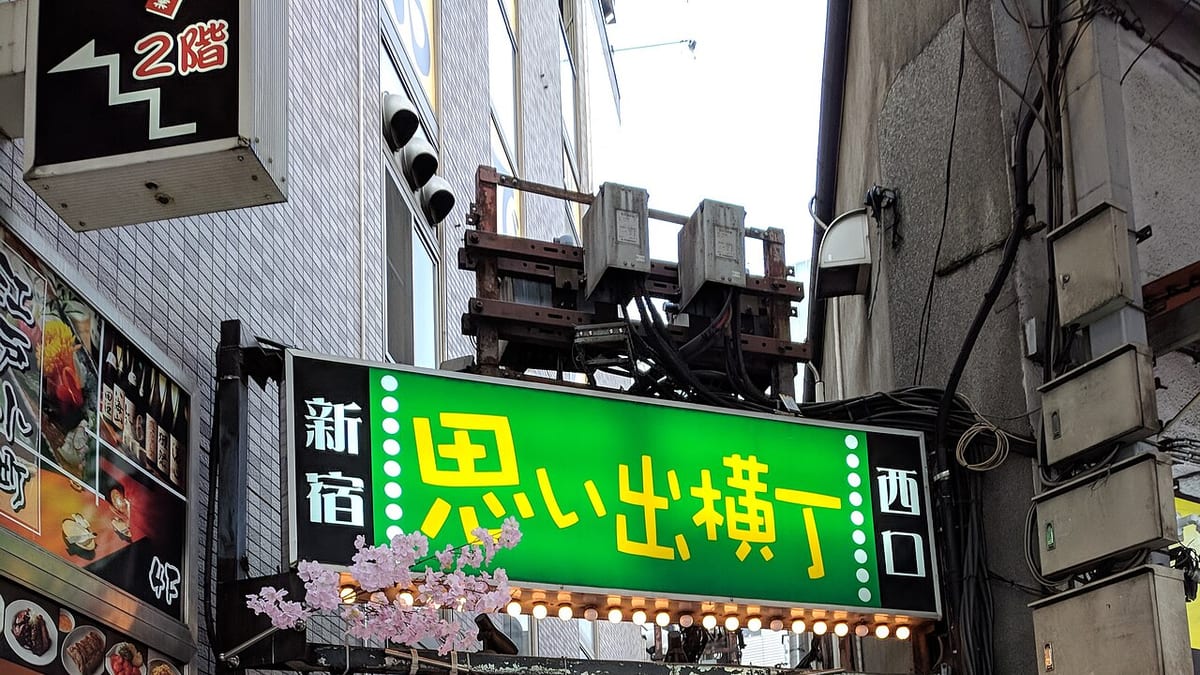
Omoide Yokocho in Tokyo is worth visiting for a compact evening of grilled food and small-bar atmosphere, especially as a solo traveller or couple. It is less suitable when your priority is a spacious, predictable restaurant experience. Go intending to eat somewhere, rather than treating the lanes and their customers as a photography set. 12
The appeal is not a long checklist of sights. It is the contrast between Shinjuku's large-scale transport and shopping district and a tightly packed collection of independent-looking food and drink premises. Your visit will work best when you choose a place that suits your appetite and accept that each business sets its own terms.
What you are actually visiting
Omoide Yokocho sits near Shinjuku Station's west side and traces its origins to the open-air market that developed after the Second World War. Its association describes a concentration of yakitori and motsuyaki businesses: chicken skewers and grilled offal are central to the area's identity. 1
That is useful context for ordering. A skewer displayed beside another skewer is not necessarily the same meat or cut. Ask what the selection contains before accepting a mixed order, particularly when you avoid offal or certain meats.
Do not choose solely by the most recognisable photograph. Think instead about the meal you want: a short stop for a few skewers, a substantial dinner, or a drink accompanied by food. Those are different purchases, and the place that looks most atmospheric from outside may not be the one best suited to your evening.
For visitors with strict dietary requirements, I would choose a confirmed suitable restaurant first and treat the lane as an additional stop. Do not depend on being able to resolve complex ingredient questions at a busy counter after you have already sat down.
Read the menu and the house rules before taking a seat
The association's first-time visitor guidance identifies several possible conditions: a table charge, a food-and-drink minimum or a time limit. These are examples of individual shop policies, not rules applied universally across the district. Its advice to bring cash is also useful, but the percentage of cash-only premises quoted on that page dates from April 2021 and is not a current survey. 3
Before ordering, establish the price of the food, whether there is an additional cover charge, and whether every person must order. If the arrangement does not suit you, decline politely before taking a seat.
Budget from the actual menu rather than from an old blog's "cheap skewer" headline. A low unit price says little about the final bill once you add several items and drinks. Equally, a clearly disclosed table charge is not evidence of a scam: the important question is whether you understand the terms and accept them.
Keep enough cash for your intended meal, but ask which payment methods the business currently accepts. There is no need to insist that every restaurant follows the same payment policy.
Choosing a place without pretending to rank the food
The association's directory is useful for identifying the kind of restaurant behind a name. Shimonya's entry describes grilled meats and offal dishes; Tsurukame Diner's entry describes rice bowls. However, both entries explicitly date their operating details to March 2021, so their listed hours and payment arrangements should not be treated as freshly verified promises. 45
Use that directory as a shortlist, then look at the business's current menu and entrance notices. The useful discovery is that the area is not one uniform yakitori restaurant: the meal format varies, even within a small district.
For two people, a counter with two available seats may be easier than trying to secure a particular photogenic corner. For a larger group, agree in advance whether you are willing to split up. Otherwise, reserve an appropriate restaurant elsewhere and walk through the area without expecting it to accommodate everyone together.
These are selection principles, not personal tasting rankings. A small menu that you understand is usually a better starting point than ordering an unfamiliar set solely because it appeared in a social-media video.
Photography is more restricted than the postcard image suggests
The association publishes photography and filming conditions that call for prior permission and prohibit obstructing passage, tripods and flash. The wording is broad; it should not be read as an automatic exemption for visitors carrying a phone rather than a large camera. Planned photography or filming should be discussed with the association in advance. 2
For an ordinary meal, ask before photographing inside a business or including staff and customers. Do not lean over another person's dinner or hold up a narrow entrance while arranging a shot. A restaurant agreeing to a photograph of your food has not necessarily agreed to filming its whole interior.
This is one reason to visit for the food rather than for a specific image. If the shop is full or photography is unwelcome, the evening can still be successful. If obtaining a staged lantern-lit photograph is your only objective, the restrictions and operating businesses may make this the wrong location for that plan.
Getting there and building a realistic evening
Use the destination's official access map rather than simply entering "Shinjuku nightlife." The association lists JR, Odakyu and Keio Shinjuku stations, Seibu-Shinjuku, Tokyo Metro's Shinjuku station and Toei Oedo's Shinjuku Nishiguchi station as nearby options. 6
Save your chosen restaurant's pin before you arrive. For the return, save the station entrance appropriate to your railway as well; the nearest visible entrance is not necessarily the easiest one for your route.
Allow a flexible meal window rather than promising yourself an exact finishing time. As an editorial planning allowance, an hour or two works better than squeezing dinner into a gap between two timed bookings. That is not a measured average or a guarantee of immediate seating.
Check your homeward journey before ordering another round. A late-night restaurant listing does not mean your rail connection runs equally late. When planning an evening around several stops, choose places that work with the same return route rather than repeatedly crossing the station area.
Who should make it a priority?
Prioritise Omoide Yokocho when you enjoy a food-focused evening, are comfortable choosing from a current menu on arrival and can adapt if your first choice is full. It can be particularly satisfying as one stop within a Shinjuku evening rather than an attraction that must occupy several hours.
Consider a conventional restaurant instead when you need substantial space, firm accessibility assurances, a guaranteed group table or carefully controlled ingredients. The association also describes shared toilets on Nakadori and permits smoking only inside businesses that allow it; do not assume every venue offers the same facilities or environment. 3
The place is worth visiting when its format suits you. The strongest plan is simple: arrive at the correct side of Shinjuku, choose a suitable business, understand the bill and give the meal your attention.
Sources
- Omoide Yokocho: official introduction and shop directory
- Omoide Yokocho: photography and filming rules
- Omoide Yokocho: first-time visitor guidance, dated 2021
- Omoide Yokocho - Shimonya directory entry (information dated March 2021)
- Omoide Yokocho - Tsurukame Diner directory entry (information dated March 2021)
- Omoide Yokocho: access