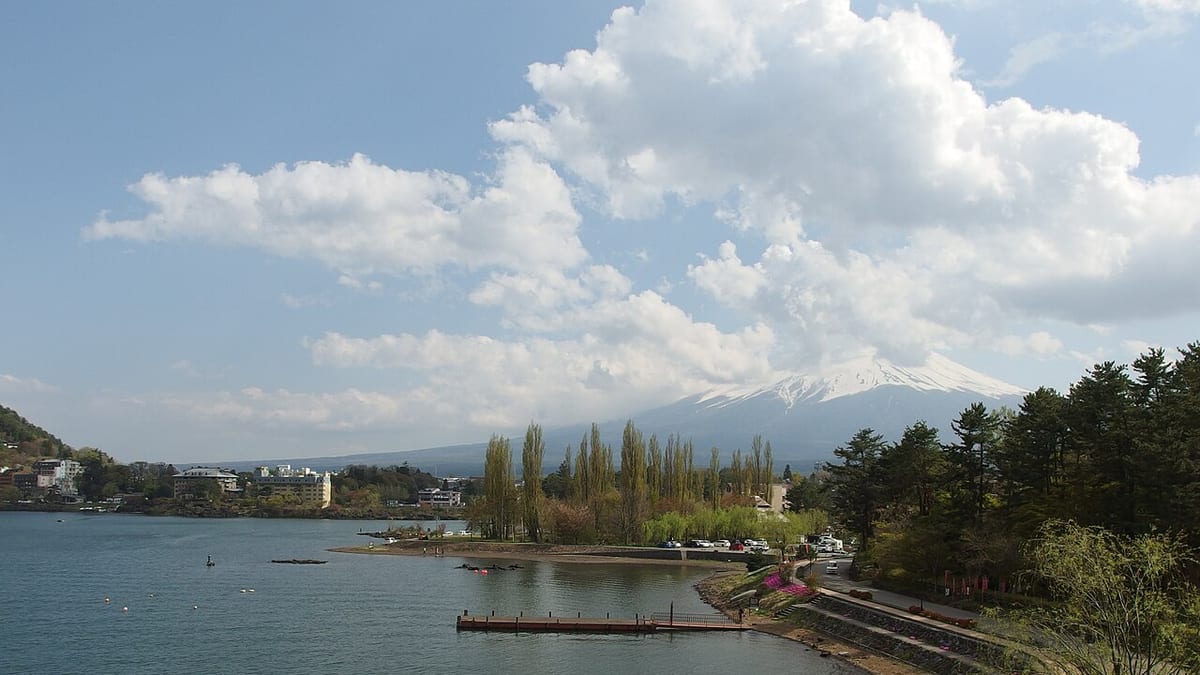
For Mount Fuji views from Lake Kawaguchiko, prioritize a clear morning and the north shore over a crowded checklist of viewpoints. Winter generally offers the strongest viewing conditions, while spring and autumn add seasonal scenery. An overnight stay gives you more opportunities than a single afternoon, but no season, hotel room or ropeway ticket guarantees that the mountain will emerge.
A useful first stop is Oishi Park, where the lake provides a foreground to Fuji. Then let the actual view determine the rest of the day: photograph a clear summit while you have it, and save indoor attractions or a long lunch for cloudier hours.
Pick the season for your real priority
Japan's national tourism organization recommends clear winter days for distant Fuji views and early morning or late afternoon for closer viewpoints. It also warns that clouds often obscure the mountain during the rainy season from early June to mid-July. Those are broad tendencies, not a probability forecast for your travel date. [1]
Winter suits the traveler whose main goal is the mountain itself. The trade-off is that waiting outdoors beside the lake can be uncomfortable, especially early in the day. Warm layers and a flexible breakfast plan matter more than an ambitious list of photo locations.
Spring and autumn are stronger choices when the lakeside landscape is equally important. Flowers or colored leaves can make the outing worthwhile even when Fuji is partly hidden. They also create a reason to enjoy a particular area slowly rather than spend the day moving between nearly identical views.
Oishi Park's local tourism information identifies lavender from roughly late June into mid-July and red kochia around mid-October. Those are different seasonal displays; a photograph showing both the mountain and a particular planting is not a promise that the same scene exists whenever you arrive. [2]
Avoid numerical visibility claims that lack a clear observation method. "Visible" might mean a momentary summit glimpse, a fully clear mountain or an all-day panorama. For an ordinary visitor, a current local forecast and live view are more useful than an unexplained percentage.
The north shore gives you the classic lake-and-mountain composition
Oishi Park is on the northern shore, with a view across the water toward Fuji. Local visitor information places it at the Kawaguchiko Natural Life Centre stop on the Red Line sightseeing bus. The park itself and the adjoining visitor facilities do not share identical opening arrangements: the outdoor space can be accessible when the centre is closed. [2]
That distinction is useful for an early start. You can plan to see the landscape before shops open, but should not assume that toilets, food service and every facility will already be available.
Choose one principal lakeside area and spend time there. A reflection requires suitable water conditions as well as a visible mountain, so moving endlessly in search of a photograph someone else took can be frustrating. A clear view without a perfect mirror image is still a successful visit.
The Maple Corridor is a separate attraction rather than a substitute for the open lakeshore. For autumn visitors, combine the two deliberately: use daylight for the mountain and lake, then the illuminated trees for a different evening experience.
The 2026 autumn festival has specific dates
The town tourism office's dated announcement schedules the Fujikawaguchiko Autumn Leaves Festival for 7–29 November 2026, with illumination from sunset until 9pm. That current announcement is more useful than an undated annual calendar or a previous year's closing time. [3]
The festival dates do not establish the exact peak of the leaves. They establish when the organized event is planned. A visitor choosing between two weekends should use current foliage reports closer to the trip rather than assume that the first or last festival day must be best.
The railway operator also describes a self-guided walking event over the same dates, linking Kawaguchiko Station, the lakeside, the Maple Corridor and Kawaguchiko Bridge. Its station registration runs in the morning, so this is not simply an evening activity you can join after dinner. [4]
For an overnight visitor, that creates a coherent day: a morning view, a lakeside walk, a rest, then the illuminated corridor. For a day-tripper, the evening portion only works when it fits the return transport you have actually booked.
The ropeway is optional - and its November price changes
The Mount Fuji Panoramic Ropeway provides a different perspective from a higher viewing area. It is worth considering when conditions are clear and you want that elevated view; it is not a reliable method of escaping clouds that obscure the mountain itself.
The operator has announced new individual round-trip fares from 1 November 2026: ¥1,200 for adults and ¥600 for children. It also lists shortened operation on 25–26 November, with the last ascent at 3pm and descent at 3:20pm, followed by a planned maintenance closure on 7–18 December. [5]
Those dates materially change an itinerary. An article quoting the previous fare or normal late-afternoon service could send you to the wrong queue at the wrong time. A November festival visit does not automatically mean the ropeway keeps operating into the evening.
The operator warns that strong wind or other severe weather can interrupt service, and that the site has many stairs. Choose the lakeshore instead when an elevated attraction's access requirements do not suit your group. [5]
The ropeway also publishes a live-camera link. Use it to inform the day's order of activities, while remembering that a live image shows the present rather than guaranteeing the next hour.
Day trip or overnight: buy time, not certainty
A day trip is reasonable when your dates are flexible and you will enjoy the lake even if Fuji remains hidden. Select the clearest available day, arrive as early as your transport allows, and make the main viewpoint the first stop.
An overnight is more persuasive when the photograph is the principal reason for traveling. It gives you an evening and another morning, reduces the pressure to fit everything between arrival and departure, and makes an early lakeshore visit practical. It improves your opportunities without buying a guarantee.
Choose accommodation by location as well as the phrase "Fuji view." A room facing the mountain may be lovely, but it does not necessarily put you beside the particular shoreline you want at dawn. Decide whether the priority is the room itself, walking access or convenient transport.
Keep a modest cloudy-day plan: a leisurely meal, a lakeside walk, or an indoor attraction that genuinely interests you. Do not spend a disappointed day paying for every elevated viewpoint in the hope that one ticket will change the weather.
The most effective Kawaguchiko itinerary is responsive rather than rigid. When Fuji is clear, stop and enjoy it. When it is not, let the lake and the season carry the day instead of treating the whole trip as a failed photograph.
Source and editor notes
Prioritizes official seasonal guidance over unsupported visibility percentages. Uses the town's 7–29 November festival announcement and 9pm illumination cutoff, resolving inconsistent secondary calendars. Ropeway fare changes and maintenance dates are explicitly future arrangements as of 27 October 2026. No clear-view guarantee is implied.