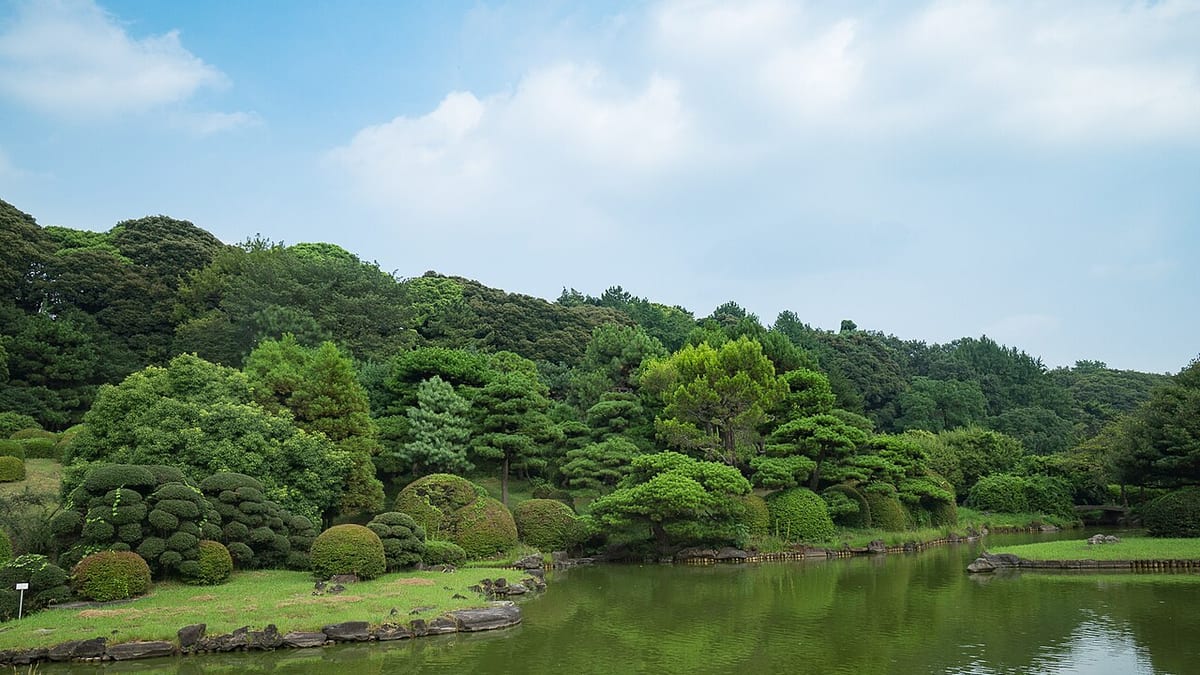
Koishikawa Botanical Gardens is worth visiting for plants, scientific history and an unhurried outdoor break, especially when you can arrive before the greenhouse closes. Choose it for a botanical collection rather than a tightly composed ornamental garden. Do not confuse it with Koishikawa Korakuen: they are different attractions, with different entrances and visiting experiences. [1][2]
The most useful practical adjustment is to treat the greenhouse as an early priority. The garden stays open later, so a visit that appears comfortably timed on a map can still miss an important part of the collection. A second adjustment is to navigate to the ticket office, not to the middle of the garden.
A university collection, not just a pleasant park
Koishikawa belongs to the University of Tokyo's Graduate School of Science. Its institutional history traces its predecessor to the Koishikawa medicinal herb garden established in 1684, and its university affiliation to 1877. Research and education remain central to the site. [1]
That identity explains the appeal. Plants are not here solely to create an attractive seasonal scene. The collection encourages attention to differences, relationships and uses: a leaf form, a plant family or an adaptation can be as interesting as a spectacular flower.
You do not need specialist knowledge to enjoy that. Pick a manageable theme, such as useful plants or unfamiliar trees, and let it guide part of the walk. Trying to learn every scientific name is unnecessary. For a first visit, looking closely at a few specimens is more rewarding than photographing labels you will never read again.
Koishikawa Korakuen, by contrast, is a historic landscaped garden associated with the Mito Tokugawa family. Choose that separate attraction when your priority is a designed garden landscape. Choose the botanical garden when a living scientific collection sounds more engaging. Neither name is a substitute for the other in a navigation app. [2]
The greenhouse determines the best arrival time
Published general opening is 9am–4:30pm, with admission ending at 4pm. The greenhouse has a shorter window: 10am–3pm. The normal weekly closure is Monday, shifted after a Monday public holiday or consecutive holiday period; the year-end closure is 29 December–3 January. [3]
For a visit of about two hours, I would aim to enter in the morning or early afternoon and see the greenhouse before the outdoor circuit. That is a suggested sequence, not an official route. It avoids spending a long time among the trees and only discovering the greenhouse's earlier closing when you reach it.
The university describes six greenhouse rooms organized around habitats or themes, including dry regions, useful plants, East Asia, the Ogasawara Islands and orchids. A separate cool-temperate house supports plants that are difficult to cultivate through Tokyo's summer heat. [4]
Use those differences to make the visit more than a walk through a warm building. Compare how plants conserve moisture, or notice how the collection shifts between a geographic theme and a practical one. The point is the contrast between groups, not completing every room at the same speed.
The operator also notes that plants may be moved or temporarily withdrawn for management reasons. A photograph of a particular specimen is therefore not a guarantee of its position on your visiting day. [4]
Historic trees add another layer to the walk
The garden's Newton apple tree is a descendant propagated from the tree associated with Isaac Newton, not the original tree transported from England. The university records the connection through material presented to Japan in 1964. That distinction makes the story more interesting: living collections can preserve scientific associations through propagation. [5]
It is worth pausing over what a botanical garden means by preservation. Some objects in a conventional museum are kept by preventing change. A living collection has to grow, be propagated and sometimes be replaced. A famous tree's significance therefore depends on its documented lineage, not simply on an impressive-looking trunk.
There is also a Japanese garden within the botanical garden. The university traces its origins to the garden of the Hakusan residence where the future fifth Tokugawa shogun, Tsunayoshi, lived as a child. This does not make it Koishikawa Korakuen; it is a historic component inside the botanical site. [6]
Combine these stops with whichever planting areas interest you rather than following a rigid checklist. The official website publishes dated flowering and foliage updates. Those reports are a better guide to a particular week than an article promising that a named flower will peak on the same date every year. [7]
Find the entrance before choosing your train
The garden explicitly recommends searching for Koishikawa Botanical Garden Admission Ticket Office, rather than just its name, when using Google Maps. This is a useful warning: the nearest point on a large site's boundary is not necessarily an entrance. [8]
Official walking estimates are about ten minutes from Hakusan Station, Exit A1, on the Toei Mita Line, and 15 minutes from Myogadani Station, Exit 1, on Tokyo Metro's Marunouchi Line. These are orientation estimates, not guaranteed door-to-gate timings for every traveler. [8]
Choose between those approaches using your starting station and the walking route, not the shortest advertised walk alone. An extra interchange can outweigh a five-minute difference outside. Build in additional time for a slower walker, heat or finding the correct exit.
There is no visitor car parking inside the garden. The official access page also identifies nearby bus stops, which may be useful when their routes fit your starting point better than the subway. [8]
Costs, comfort and the rules that shape the visit
Admission is JPY 500 for high-school age and above, JPY 150 for elementary and junior-high pupils, and free for children under six. Two adults and two children in the school-age concession category therefore pay JPY 1,300, calculated from the published individual rates. [3]
Food and non-alcoholic drinks are permitted, but visitors must take their rubbish away. Re-entry is not allowed. Bring what you need for a modest break before entering rather than planning to leave for lunch and return on the same visit. Collecting plants or fallen material, feeding animals and bringing pets other than assistance dogs are prohibited. [3]
For children, choose observation rather than collecting as the activity. Look for contrasting leaf shapes or discuss the difference between plants in the greenhouse rooms. A botanical collection should not be treated as a source of souvenir leaves or a substitute playground.
The grounds include different levels and slopes, according to the university's description. Anyone needing a specific accessible circuit should obtain route advice rather than infer that every part is equally easy to reach. [1]
This is an especially good choice when your Tokyo itinerary needs a slower stretch without abandoning a sense of discovery. It is less suitable as a hurried final stop close to closing time. Give the collection enough daylight, reach the correct entrance and visit the greenhouse first; those decisions matter more than trying to see everything.
Sources
- University of Tokyo: Koishikawa Botanical Gardens overview
- Tokyo Metropolitan Park Association: Koishikawa Korakuen
- Koishikawa Botanical Gardens: general information
- Koishikawa Botanical Gardens: greenhouse collections
- Koishikawa Botanical Gardens: Newton apple tree
- Koishikawa Botanical Gardens: Japanese garden
- Koishikawa Botanical Gardens: dated flowering and foliage reports
- Koishikawa Botanical Gardens: access and entrance