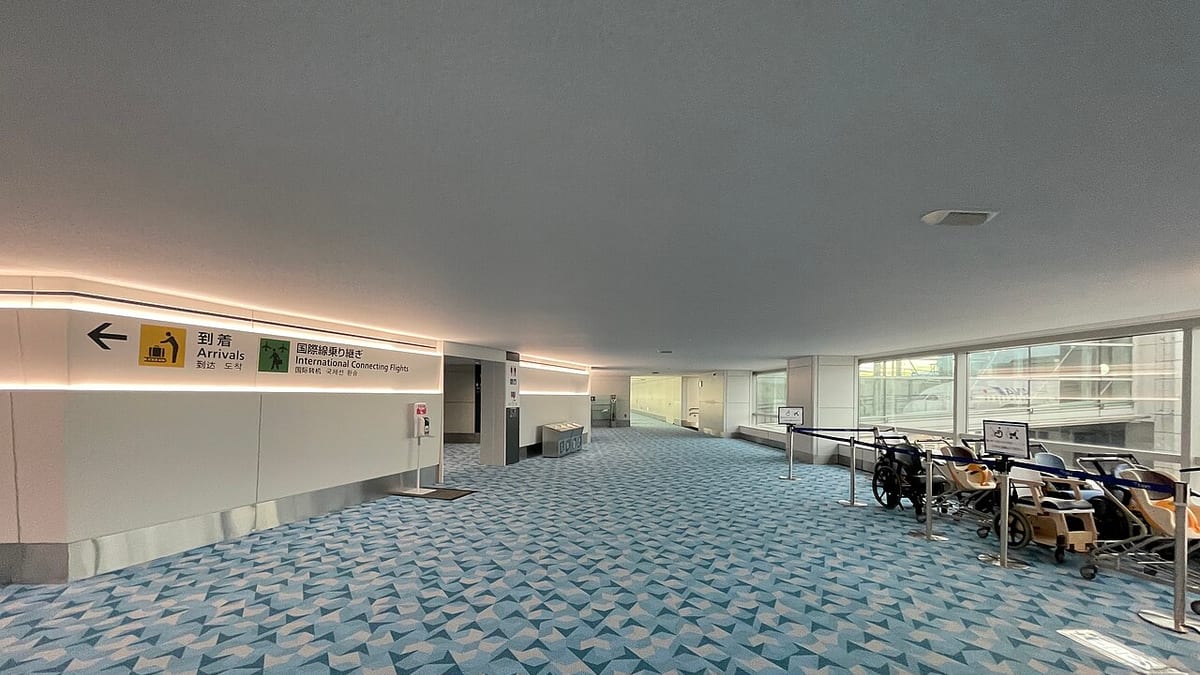
Arrive at Haneda around three hours before an international flight; for a domestic flight, two hours is a sensible first-time visitor's planning allowance. The domestic recommendation is not a universal airline rule. Your terminal, baggage cutoff and gate location matter, especially after the September 2026 changes to baggage acceptance and Terminal 1's North Satellite. [1][2]
A fast train to the airport does not make the rest of the departure automatic. Work backwards from the earliest relevant airline requirement, then allow for the terminal route. In particular, do not confuse arriving at an airport station with reaching the correct counter or security checkpoint.
Start with the right terminal and flight type
ANA uses both Terminals 2 and 3 for its international flights. Its guidance also warns that the international and domestic departure areas within Terminal 2 are different. A remembered rule that "international means Terminal 3" is therefore not sufficient for every Haneda booking. [3]
Check the operating airline and current flight status before choosing the rail stop or taxi destination. An ANA-marketed codeshare operated by another carrier should not be assumed to use the same terminal as an ANA-operated flight. The airline's terminal notice makes that distinction explicitly. [3]
If a booking shows a placeholder rather than a clear terminal, resolve it through the flight-status information before travelling. The time spent correcting a wrong-terminal arrival consumes the same margin you need for check-in and security; it is not a separate allowance magically added to your flight.
For a family or a traveller needing assistance, choose the confirmed meeting point first and plan the route to it. A general journey planner may stop at the station while your appointment is at a specific departure counter several stages further on.
Domestic deadlines became more important in September 2026
JAL's current Haneda domestic guidance gives three distinct limits: checked baggage must be accepted by 30 minutes before departure, security must be passed by 20 minutes before departure, and passengers must be at the gate by ten minutes before departure. The strict baggage deadline took effect on 1 September 2026. [4]
ANA's Haneda Terminal 2 guide also states that domestic checked-baggage acceptance closes 30 minutes before departure from September 2026. These airline notices are a reason to disregard older advice that treats a late bag drop as a negotiable part of a quick domestic departure. [5]
For an illustrative JAL flight at 10:00, the latest published milestones are 09:30 for baggage, 09:40 for security and 09:50 for the gate. They are separate cutoffs, not a recommended itinerary. Arriving at the airport at 09:30 would leave no margin for getting a bag accepted by 09:30.
A two-hour arrival target gives a first-time visitor time to locate the right wing, complete baggage procedures and respond to a queue or gate change. Someone travelling frequently with no checked bag may choose a shorter allowance, but that is a personal risk decision rather than a general recommendation for an unfamiliar airport.
For busy periods, JAL asks passengers to pass security at least 30 minutes before departure, earlier than its basic 20-minute cutoff. A remote gate may justify allowing more again. [4]
The new North Satellite shows why the last cutoff is not enough
JAL's North Satellite notice identifies Gates 26–29 in Terminal 1 and gives approximate walks of 16 minutes from security checkpoint E and 15 minutes from checkpoint F. The facilities entered use from 1 September 2026. [2]
Consider the 10:00 example again. Passing security at 09:40 and then taking a 16-minute walk would put you at the gate around 09:56, later than the 09:50 gate deadline. That is a calculation using JAL's published timings, not a prediction of how fast a particular traveller will walk. It demonstrates why meeting one minimum does not guarantee meeting the next. [2][4]
For that kind of gate assignment, I would aim to be through security around 45 minutes before departure, with additional allowance for assistance or slower walking. This is an editorial planning margin, not an extra airline rule. It gives the remaining route room to happen without depending on a perfect sequence.
The same North Satellite notice warns of unstable mobile reception near the gates and asks passengers to save a screenshot of their boarding barcode beforehand. That is a small preparation step with a useful consequence: your ability to display the pass does not depend on loading it at the last moment. [2]
Confirm the gate again after security. Do not choose a café solely by proximity to the checkpoint when the actual boarding location is much farther away.
International travel needs a different clock
Haneda's international departure planner recommends arrival three hours before departure. ANA's international guidance requires check-in and checked-baggage procedures to be completed at least 60 minutes before departure and asks passengers to reach the gate at least 30 minutes before departure. These are not the same rules as the domestic milestones above. [1][6]
For a hypothetical 12:00 ANA international flight, that means a 09:00 airport-arrival target, check-in completed by 11:00 and presence at the gate by 11:30. Use the boarding pass and any more specific flight instruction to refine that plan. These calculated times are not a claim that the necessary queues always fit a fixed duration.
International online check-in can still involve document checks or bag drop. ANA states that codeshare counter arrangements and deadlines can vary with the operating airline. A pass in an app therefore does not justify importing a different carrier's shortest published cutoff. [6]
Leave shopping and meals until you understand the remaining route and required gate time. The scheduled departure is when the aircraft is due to leave, not the moment passengers should first appear at the boarding desk.
Calculate the whole journey, including the previous evening
Separate the airport-arrival target from the transfer to Haneda. Include reaching the station, the train or road journey, the correct terminal stop and movement to departures. A rail ride advertised as fast is only one part of that calculation.
For a 10:00 domestic flight and an 08:00 departure-area target, suppose you allow 50 minutes for the complete hotel-to-terminal journey and 20 minutes of margin. You would leave at approximately 06:50. Those figures are a worked planning example, not a promise about travel from any named Tokyo hotel.
Flights shortly after midnight require particular care. For an international departure at 00:20 on 29 October, arriving three hours earlier means 21:20 on 28 October. Put the actual pickup date into your booking rather than asking vaguely for a ride "on the night of the flight."
For a connecting itinerary, use the airline's connection instructions rather than treating the layover as an ordinary departure from the city. Terminal changes, baggage collection and separate tickets can alter the required process; establish those details before assuming you can leave the airport or shorten the connection.
The best Haneda plan is not the smallest number of minutes someone else once managed. It is the one that gets your party, bags and documents through the correct sequence, with the final walk to the aircraft still comfortably inside the boarding deadline.