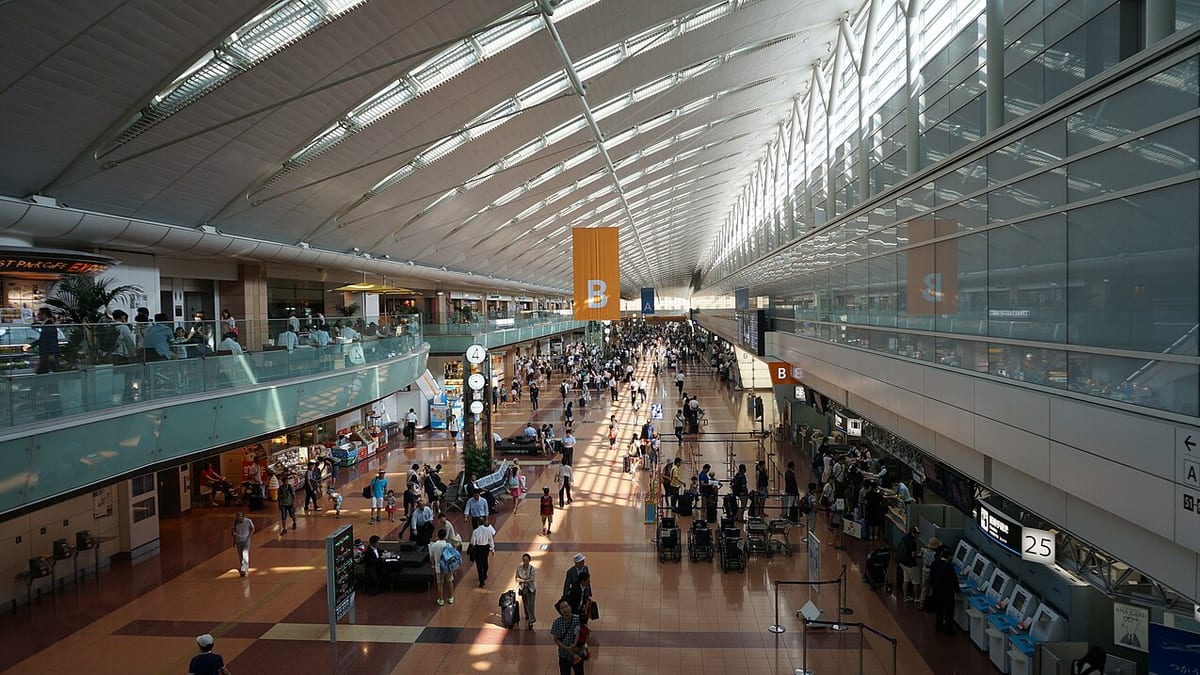
Haneda Airport luggage storage offers two different solutions: staffed counters for bags requiring personal handover, and lockers for items that fit an available compartment. Choose within your flight's terminal whenever possible. Terminal 3 has 24-hour staffed storage, but the equivalent counters in Terminals 1 and 2 close in the evening, and locker prices are not identical across terminals. [1][2]
Start with your terminal and collection time
The airport lists ordinary staffed storage in Terminal 1's B1 south lobby and Terminal 2's B1 north lobby, both 08:00–19:30. In Terminal 3, the arrivals-floor and departures-floor temporary-storage counters are listed as 24 hours. [1]
A late-evening pickup therefore needs more thought than "leave it at Haneda." If you deposit at a counter that closes before you return, being inside the airport does not make the suitcase accessible. Write the counter's closing time alongside your flight details.
Do not automatically send every international passenger to Terminal 3. Confirm the terminal shown for your actual flight, then choose the storage point. An unnecessary terminal transfer is especially inconvenient when you are retrieving heavy luggage before check-in.
The counter you use on arrival need not be the most convenient one for departure. For a stay lasting several days, decide whether avoiding luggage on the city journey is worth returning to that particular location later.
Keep the receipt, passport and essential medication with you. Also record the terminal, floor and operator. "The luggage desk downstairs" is not a useful collection instruction in an airport with several different baggage businesses.
Staffed-counter prices and limits
Haneda's ordinary temporary-storage listing uses the sum of a bag's three dimensions. It publishes JPY800 for under 120 centimetres, JPY1,000 for 120 to under 200, and JPY2,000 for 200–300. Terminal 3 explicitly quotes those charges per 24 hours; the Terminal 1 and 2 listings say per day. [1]
The published general limit is two weeks, with a maximum combined dimension of 300 centimetres and weight of 30 kilograms, subject to acceptance of the item's shape. [1]
Ask how the charging day is applied at the counter you choose, particularly when crossing midnight. Do not silently transfer Terminal 3's explicitly stated 24-hour calculation to a differently worded listing elsewhere.
Measure unusual equipment before travelling. A narrow but very long object may not fit a locker even when its total dimensions fall within the staffed-counter limit. Contact the operator about acceptance instead of relying on a photograph of someone else's suitcase.
The airport also lists delivery businesses and bonded custody services. These are not interchangeable with ordinary temporary storage. Use the service name on your receipt to establish exactly what has been purchased. [1]
Lockers: cheaper can mean a different fit
All the airport's listed coin lockers are outside the gates. The current maximum storage period is seven days, with a day counted as 24 hours from the start of use. [2]
In Terminal 3, the standard published rates are JPY500, JPY700 and JPY900 for small, medium and large compartments. The south departures-floor location also lists an extra-large option at JPY2,000. Terminal 1 and 2 listings commonly start at JPY400, JPY500 and JPY600, with larger sizes priced separately. [2]
This is why a generic "Haneda lockers from JPY400" headline is not enough for someone arriving at Terminal 3. Equally, it is not worth changing terminals solely because another building advertises a lower small-locker price.
The standard large compartment is approximately 35.2 centimetres wide, 67.8 deep and 87 high. Compare those internal dimensions with your suitcase, including protruding wheels and handles. The airport links live availability from its locker page, but availability is not the same thing as a reserved compartment. [2]
A large suitcase that fits a JPY900 Terminal 3 locker might also fall into the staffed counter's JPY1,000 size category. In that example the difference is only JPY100 for the first 24 hours. Paying the small difference can be sensible when it avoids searching for an empty locker; conversely, a ready-to-use locker may be faster when you have a simple bag and clear collection plan.
Treat that as a conditional comparison, not a universal saving. The bag must fit, and the charge shown on the actual locker or counter is the one to accept before payment.
Decide whether the bags should stay at the airport at all
Airport storage is particularly useful when you have a brief Tokyo outing before another flight from Haneda, or when you want to leave surplus luggage while travelling elsewhere and will return through the same airport.
It is less compelling when your final departure is from Narita. Returning to Haneda only to collect a suitcase creates another journey. A hotel or a suitably located city storage point may fit that itinerary better, subject to its own acceptance and opening arrangements.
For a hotel stay, ask about holding bags before check-in or after checkout. Keep the request specific: date, number of pieces and collection time. A hotel's willingness to help its own guests does not mean it offers public luggage storage.
Do not describe a central-Tokyo partner as "near Haneda" merely because both appear on the same booking website. Compare the whole route, including collection, not just the storage fee.
Delivery is useful, but has different deadlines
Ecbo distinguishes its storage service, ecbo cloak, from ecbo delivery. Its delivery site advertises same-day services from stations or airports to accommodation, and hotel-to-airport arrangements, with prices starting at JPY1,600. [3]
The listed Haneda Terminal 3 collection window is 07:00–16:00. That is not a 24-hour luggage-storage counter. The service page also gives location-specific drop-off times and says booking deadlines vary. [3]
For an evening flight, collecting before the delivery desk closes may still be possible, but it changes your afternoon itinerary. For a morning flight, do not assume a bag handed over at a city hotel that morning will reach the airport in time.
Confirm the direction, destination, delivery date, collection window and who is authorised to receive the luggage. Keep overnight essentials and flight documents out of anything sent ahead.
The best arrangement is the one that leaves you a straightforward final journey. Use a locker for a fitting bag and predictable return, a staffed counter for help with acceptance or longer storage, and delivery only when its timetable genuinely removes a detour rather than creating a new deadline.