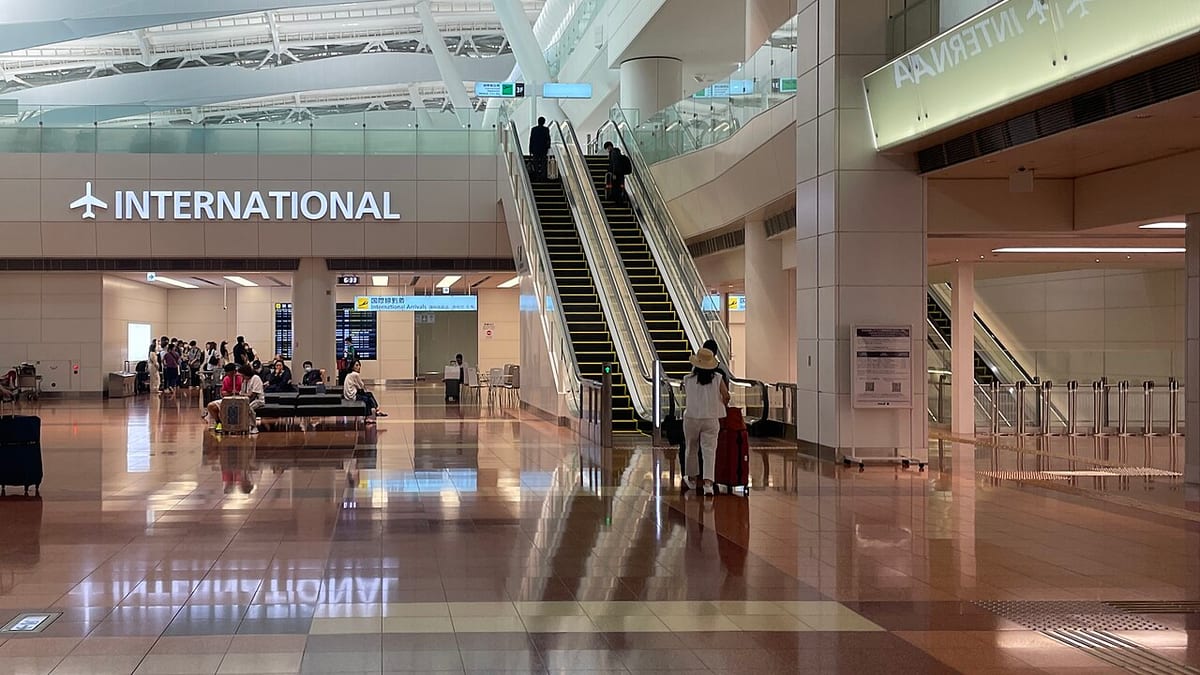
Haneda Airport car rental works best when you are leaving Tokyo for a road trip, not spending several days sightseeing in the city. Book the actual rental branch, confirm your arrival terminal and allow for a shuttle: an airport counter is often a reception point rather than the place where your vehicle is waiting. [1][2]
The most consequential detail is timing. Counter hours, branch hours and the last shuttle can differ. A reservation labelled "Haneda Airport" does not establish that collection is available whenever an international flight lands. Check all three before choosing a supplier, particularly for evening arrivals or early departures. [1][3][4]
Match the supplier to the terminal and the branch
Haneda's directory lists Orix, Times, Nissan, Nippon and Toyota among its rental operators. Terminals 1 and 2 have counters on their first-floor arrival levels; Terminal 3's rental reception is on the second-floor arrivals level. The airport publishes 08:00–20:00 for the Terminal 3 counter, while individual Terminal 1 and 2 listings vary. [1]
These are reception details, not a promise of cars parked outside every counter. Toyota's published instructions describe shuttle transfers to its rental branches, with different arrangements for each terminal. Its Terminal 3 route goes through the arrivals travel counter before transfer to the international branch; its Terminal 2 instructions can lead to either the domestic or international branch. [2]
Provide the flight number and terminal when reserving. Do not substitute a generic map pin for the supplier's instructions, and do not walk to another terminal merely because an older review mentions it. The useful confirmation is a written sequence: where to report, how to contact staff, which branch holds the car and where it must be returned.
For a vehicle with child seats, specialist equipment or substantial luggage capacity, confirm the equipment as well as the class. A nominal passenger capacity does not tell you how many large suitcases fit behind the occupied seats. A smaller vehicle may be easier to park, but it is not a saving when bags cannot be carried safely.
The evening cutoff can be earlier than the office closing time
Times' Haneda branch currently lists 09:00–19:00 Monday to Thursday, with the airport shuttle ending at 18:30. Friday to Sunday and the day before holidays, it lists 09:00–20:00, with the shuttle ending at 19:30. Its arrival instructions allow roughly 20–40 minutes for the collection transfer arrangement, depending on operations. [3]
Nippon's branch information presents a different operating window: the Haneda office lists 07:00–22:00, with shuttle service ending at 21:30. [4] Those longer branch hours do not mean the airport reception counter is staffed for the same period. An arrival outside the counter's published hours needs a supplier-confirmed procedure, not an assumption that the later office closing time solves everything.
Compare your expected time after immigration and baggage reclaim with the last usable collection arrangement. Scheduled landing time is not collection time. For a flight arriving close to the cutoff, an overnight stay followed by a morning rental may be more sensible than a prepaid booking that depends on every arrival step being unusually quick.
Ask what happens after a delayed flight and how to contact the branch. Save the answer offline. Do not assume that supplying a flight number automatically obliges the operator to remain open, or that a broker's support line can authorise an after-hours handover.
Bring the right driving documents before leaving home
The driving-document requirement depends on the licence you hold. Japan recognises qualifying 1949 Geneva Convention international driving permits, not every document marketed as an international licence. Tokyo Metropolitan Police distinguishes these from other formats and sets out the relevant validity limits. [5]
A separate route applies to certain foreign licences accompanied by an authorised Japanese translation. JAF identifies licences from Switzerland, Germany, France, Belgium, Monaco and Taiwan for that arrangement. [6] Do not assume an English-language domestic licence removes the requirement, and do not buy an unofficial online translation because it resembles a familiar document.
Carry the originals required by the supplier, your passport and appropriate evidence of entry into Japan. Toyota specifically warns that it needs to establish the entry date; travellers using automated immigration procedures should arrange the necessary entry evidence rather than discover the problem at the rental counter. [7]
Have the branch confirm your exact licence and permit combination before prepaying. Legal eligibility, supplier acceptance, payment-card conditions and minimum licence-holding periods are separate checks. A successful online reservation does not prove that the counter can legally release the car.
Compare the complete rental, not just the headline rate
Request a quote for the same collection and return times, vehicle class and equipment. Include protection options, an additional driver where relevant, an ETC card if needed, one-way charges and any fee associated with the actual return branch. Keep fuel, tolls and accommodation parking outside the rental comparison unless explicitly included.
Protection terminology deserves attention. A collision-damage waiver and a non-operation-charge waiver address different liabilities. Toyota's protection information describes packages combining these elements, subject to their conditions; the presence of "insurance" in a booking description does not mean every damage charge or operational loss is waived. [8]
Ask for the excess, exclusions and accident-reporting procedure in a form you understand. Photograph the vehicle at collection, including wheels and existing damage, and have discrepancies recorded before departure. This is documentation, not a replacement for complying with the operator's reporting requirements.
A useful comparison is the amount payable at collection plus the amount potentially left at risk. The lowest daily price can be a poor choice when it comes with unsuitable collection hours, an inconvenient return branch or protection you would immediately need to add.
Work backwards from the terminal arrival you need
For Toyota's published international-airport return arrangement, the vehicle goes to the rental branch, not directly to the passenger terminal. After the return procedure, its courtesy transfer takes roughly 15–20 minutes under normal road conditions, potentially longer in traffic. [2] Times also explicitly states that vehicles cannot be returned at the airport itself. [3]
Use your airline's required terminal arrival time as the anchor. Add the supplier's return processing, shuttle wait and journey, plus refuelling and a sensible contingency. Do not interpret a branch's general minimum return advice as permission to reach an international departure terminal unusually late.
Save the return entrance while collecting the vehicle. An airport has multiple roads, terminals and car parks, and a navigation result for "Haneda Airport" is not a rental-return instruction. Confirm whether a change of departure terminal affects the transfer and whether an earlier return is needed for your flight.
For a very early flight, returning the evening before can remove the dependency on morning branch opening and shuttle service. For several nights in central Tokyo before departure, compare ending the rental when the road trip finishes and using public transport for the remaining city stay. Haneda's official access information provides rail, monorail and bus alternatives. [9]
The best Haneda booking is therefore the one that fits the whole journey: valid documents, an achievable collection window, an appropriate car and a return that reaches the correct terminal comfortably. Brand recognition alone cannot settle any of those details.
Sources
- Haneda Airport: rental counters and terminal hours
- Toyota: Haneda terminal collection and return instructions
- Times Car Rental: Haneda branch and shuttle cutoffs
- Nippon Rent-A-Car: Haneda branch 512479
- Tokyo Metropolitan Police: international driving permits
- JAF: driving in Japan with an eligible foreign licence
- Toyota: documentation and evidence of entry
- Toyota: insurance and protection packages
- Haneda Airport: access options