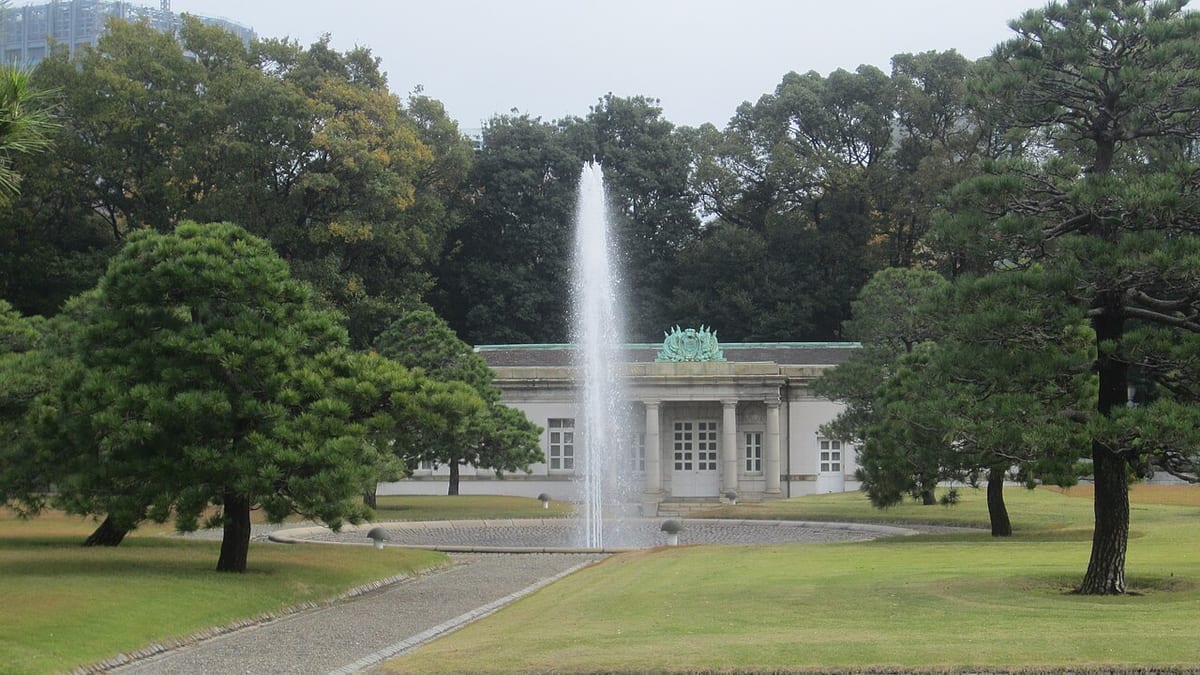
Akasaka Palace is worth visiting for architecture, decorative arts and an unusual view of Japanese state hospitality. Choose the main building for grand ceremonial interiors; add the Japanese-style annex only when that contrasting experience genuinely interests you. It is less essential for travellers seeking an imperial-residence tour, a large museum collection or a full day of activities. [1][2]
The palace's appeal is more specific than its occasional comparison with Versailles suggests. Built in 1909 for the Crown Prince and later adapted as a state guest house, it combines European architectural ambition with Japanese craftsmanship. Today it still serves diplomatic purposes rather than functioning solely as a visitor attraction. [2][3]
Why the interiors are the reason to come
The building was designed under Katayama Tokuma, and its importance is not simply that it looks European. The Agency for Cultural Affairs identifies it as a major achievement in Japan's adoption and development of Western architecture, with Japanese subjects incorporated into elaborate decorative work. [3]
That gives you a useful way to look at the rooms: notice where a European composition contains something recognisably Japanese. Rather than trying to memorise every ceiling, compare the room's overall form with its smaller motifs and materials. This is a more rewarding approach than walking through as quickly as possible to collect photographs of ornate spaces.
JNTO highlights the formal reception rooms, the Noh-related ceiling imagery in Hagoromo no Ma and the mixture of French-style decoration with Japanese elements elsewhere. These are architectural examples, not a guarantee that every named room will be included on every day's route. [2]
Allow time for interpretation. An audio guide can make sense when your interest is more than visual: GO TOKYO lists guides in several languages, including English. [1] Ask which guide corresponds to the route you have bought, especially when additional areas are available. A longer route without context is not automatically better than a shorter visit in which you understand what you are seeing.
The former palace's use also changes the experience. You are entering a place used to receive important visitors, not a preserved domestic home arranged to show the everyday life of an imperial family. That distinction explains both the grandeur and why access can be affected by official business. [2]
Main building, Japanese annex or premium route?
For most first-time visitors, start with the main building and gardens. GO TOKYO describes ordinary main-building admission as available without an advance reservation, through the west gate. The Japanese-style annex, Yushintei, requires a separate advance reservation; its guided format is not interchangeable with independent admission to the main building. [1]
The annex is the more logical addition for someone interested in the contrast between different forms of hospitality. JNTO describes Japanese architectural and garden elements there, rather than another set of European-style reception rooms. [2] Book it for that contrast, not because the word "annex" sounds like a missing part of the main ticket.
A third option now complicates older guides. Government information published in September 2026 describes a premium viewing route introduced that July, including previously unshown areas such as the East Room and entrance or corridor spaces. It quotes a JPY 400 supplement to standard admission. That premium route is distinct from the Japanese annex. [4]
When booking, read the actual areas included rather than choosing the longest-sounding package. An architecture enthusiast may value additional main-building interiors more than a garden-focused visit. Someone particularly interested in Japanese design may prefer reserving the annex and leaving less time for optional Western-style spaces.
For a mixed-interest family or group, agree on one main objective first. A single focused visit is easier to enjoy than combining every possible route while some travellers would rather spend the afternoon elsewhere. Check the age and access conditions of any guided option before paying; do not assume rules for the main building also apply to the annex.
What the price information now means
Older listings need care. GO TOKYO's page, last updated in November 2025, still displays JPY 1,500 general admission. The government's September 2026 programme quotes JPY 1,800 for ordinary admission, and a dated heritage listing reports that the revised main-building-and-gardens rate took effect on 17 September 2026. [1][4][5]
Use JPY 1,800 as the current published adult reference rather than budgeting from the older JPY 1,500 listing. Adding the quoted JPY 400 premium supplement gives a calculated JPY 2,200 before any separately charged guide or different tour product. This is not a live reservation quote, and it does not represent a combined Japanese-annex package.
The relevant value question is whether the interior visit earns its place in your itinerary. Travellers who enjoy architecture can get more from one carefully observed palace than several hurried landmark stops. Those whose main interest is gardens or open space should compare a garden-focused alternative instead of paying for rooms they do not particularly want to explore.
Avoid selecting a tour solely because its total price is higher. Determine whether it includes admission, a human guide, transport, extra areas or simply booking assistance. Those are different services, and the standard entry price is only one component of that comparison.
Put it into a Tokyo day without overplanning
Yotsuya is the practical rail approach. JNTO identifies the JR Chuo-Sobu services and the Tokyo Metro Marunouchi and Namboku lines, with roughly a seven-minute walk from the station. [2] Navigate to the visitor entrance rather than assuming the most prominent gate is where admission begins.
For planning, reserve around two hours for a main-building-and-gardens visit, with extra time for a separately booked annex tour or a slower architectural visit. That is an editorial allowance, not a measured average or guaranteed route duration. Do not compress a guided reservation between two tightly timed appointments.
The published general schedule is 10:00–17:00, with last entry at 16:00 and a normal Wednesday closure, subject to holiday adjustments. [1] More importantly, this is a working state guest house: JNTO warns that public access can change at short notice. [2] Confirm the date-specific visitor calendar before making the palace the immovable centre of your day.
The operator's live visitor pages were not accessible during this review, so no specific October or November closure is asserted here. That is a reason to confirm the calendar, not to assume that the building is closed. Keep a nearby, unbooked alternative in reserve rather than abandoning the visit because an older tourism page carries outdated information.
Who should prioritise it - and who can skip it
Prioritise Akasaka Palace when you enjoy noticing materials, decoration and the way architecture communicates status. It also works well after several days dominated by contemporary neighbourhoods, because the main interiors offer a sharply different visual experience. The case for visiting rests on the building itself, not on claiming it is an undiscovered attraction.
Skip or shorten it when your available time is already committed to other interests. It is not a substitute for seeing the wider Imperial Palace area, and the state guest house's public route should not be mistaken for access to the Emperor's residence. Its history and present diplomatic role are its own subject. [2][3]
For most interested travellers, the main building is enough to establish why the palace matters. Add the annex or premium route because you can explain what you hope to see there - not because a checklist implies that a visit is incomplete without every available ticket.